EU cosmetic rules
Guides to EU cosmetic requirements under Regulation (EC) No 1223/2009: ingredient limits and prohibitions from Annexes II–VI (consolidated text of 18.05.2026), labeling duties such as the nano bracket and allergen naming, the responsible person, and the CPNP notification. Every figure cites its Annex and entry number; anything we could not verify against the consolidated text is marked as unverified rather than guessed.
EU rules2026/11/10
Alpha-arbutin in the EU: 2% face cream, 0.5% body lotion
The EU caps alpha-arbutin at 2% in face cream and 0.5% in body lotion, with hydroquinone allowed only at unavoidable trace level (Annex III No 377). The US has no federal cosmetic limit.
EU rules2026/11/10
Benzyl alcohol in cosmetics: the 1% cap and the allergen listing rule
In the EU, benzyl alcohol is capped at 1% as a preservative (Annex V No 34); used for other purposes it must be individually listed above 0.001% in leave-on and 0.01% in rinse-off products (Annex III No 45). The US has no federal limit.
EU rules2026/11/10
CPNP vs FDA: what each registration actually asks for
The EU's CPNP notification (Article 13) and the FDA's facility registration and product listing (FD&C Act §607/§608) are different filings, made by different parties, at different times. One does not substitute for the other.
EU rules2026/11/10
DMDM hydantoin: how much formaldehyde it releases, and the label rule
The EU allows DMDM hydantoin up to 0.6% (Annex V No 33) and requires a “releases formaldehyde” statement on any cosmetic releasing more than 0.001% (10 ppm) total formaldehyde. The US sets no federal cap.
EU rules2026/11/10
CMR substances in EU cosmetics: the ban and the four-part exception
The EU bans CMR substances from cosmetics (Regulation 1223/2009, Article 15). Category 2 can return after an SCCS safety evaluation; category 1A/1B only through a four-part exception including an analysis of alternatives.
EU rules2026/11/10
EU fragrance allergen labeling: the thresholds and the expanded list
Named fragrance allergens must appear in the EU ingredient list when they exceed 0.001% in leave-on and 0.01% in rinse-off products (Annex III, per Article 19(1)(g)), and Regulation (EU) 2023/1545 expanded the list beyond the classic 26. The US has no allergen-specific rule.
EU rules2026/11/10
EU responsible person: what a US brand needs before selling in the EU
Only cosmetic products with a designated ‘responsible person’ established in the EU may be placed on the EU market (Regulation 1223/2009, Article 4), and the label must carry that person's name and EU address (Article 19(1)(a)). A US brand must appoint one.
EU rules2026/11/10
Is hydroquinone banned in EU cosmetics?
Yes. Hydroquinone is on the EU Annex II prohibited list (No 1339), with one narrow exception for professional artificial nail systems. Arbutin and alpha-arbutin formulas also have trace-level hydroquinone conditions. What the rule actually says.
US rules2026/11/10
Do ingredients under 1% have to be listed in order?
Both the US and the EU allow a two-block layout: ingredients above 1% in descending order, then everything at 1% or less in any order, then color additives. But the under-1% block cannot float anywhere in the list. The rule text, side by side.
EU rules2026/11/10
Kojic acid in the EU: 1%, face and hand products only
The EU limits kojic acid to 1% and only in face and hand products (Annex III No 375). Body lotions and neck-below products cannot use it. The US bans it from cosmetics nowhere — but skin-lightening claims change the product's category.
EU rules2026/11/10
Limonene and linalool on EU labels: the 0.001% rule
In the EU, limonene (Annex III No 88) and linalool (No 84) must be individually named in the ingredient list above 0.001% in leave-on and 0.01% in rinse-off products; limonene also needs a peroxide value below 20 mmol/L. The US allows them under “fragrance”.
EU rules2026/11/10
Methylisothiazolinone (MIT) in the EU: rinse-off only
The EU allows methylisothiazolinone only in rinse-off products at up to 0.0015% (15 ppm) — Annex V No 57 — and bans it from leave-on products entirely. The US sets no federal cosmetic limit.
EU rules2026/11/10
“Nano” on EU cosmetic labels: the bracket rule
In the EU, every ingredient present in the form of a nanomaterial must be followed by the word “nano” in brackets in the ingredient list (Regulation 1223/2009, Article 19(1)(f)). The US has no comparable cosmetic label rule.
EU rules2026/11/10
Parabens in the EU: the 0.4%, 0.8% and 0.14% limits
The EU caps methyl- and ethylparaben at 0.4% each (0.8% combined, as acid) and propyl-/butylparaben at 0.14% combined, with a nappy-area ban for products for children under three (Annex V No 12 and 12a). The US sets no federal limit.
EU rules2026/11/10
Phenoxyethanol in EU cosmetics: the 1% limit
Phenoxyethanol is capped at 1.0% in EU cosmetics when used as a preservative (Annex V No 29). The US has no federal cap. Here is the exact rule, the labelling, and the mistakes we see in formula sheets.
EU rules2026/11/10
Potassium sorbate in cosmetics: the 0.6% EU limit
In the EU, sorbic acid and its salts — including potassium sorbate — are capped at 0.6% as acid in cosmetics (Annex V No 4). The US sets no federal limit.
EU rules2026/11/10
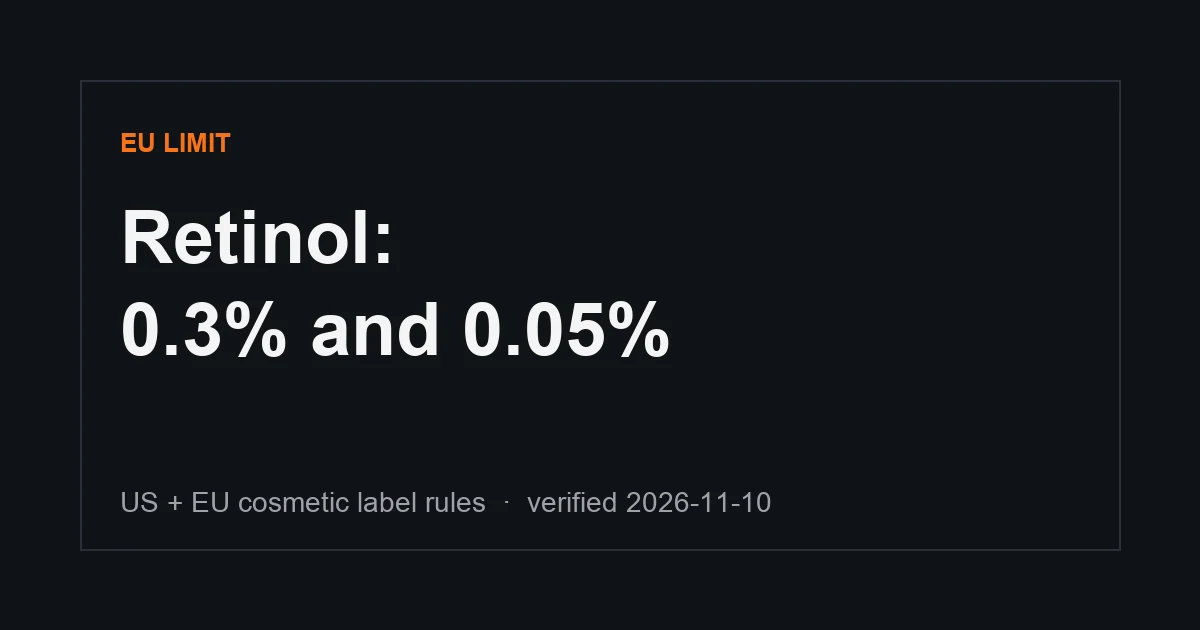
Retinol in EU cosmetics: the 0.3% limit
The EU caps vitamin A in cosmetics at 0.05% retinol equivalent in body lotion and 0.3% in other leave-on and rinse-off products (Annex III No 376), and mandates a vitamin A warning on the label. The US has no federal cap.
EU rules2026/11/10
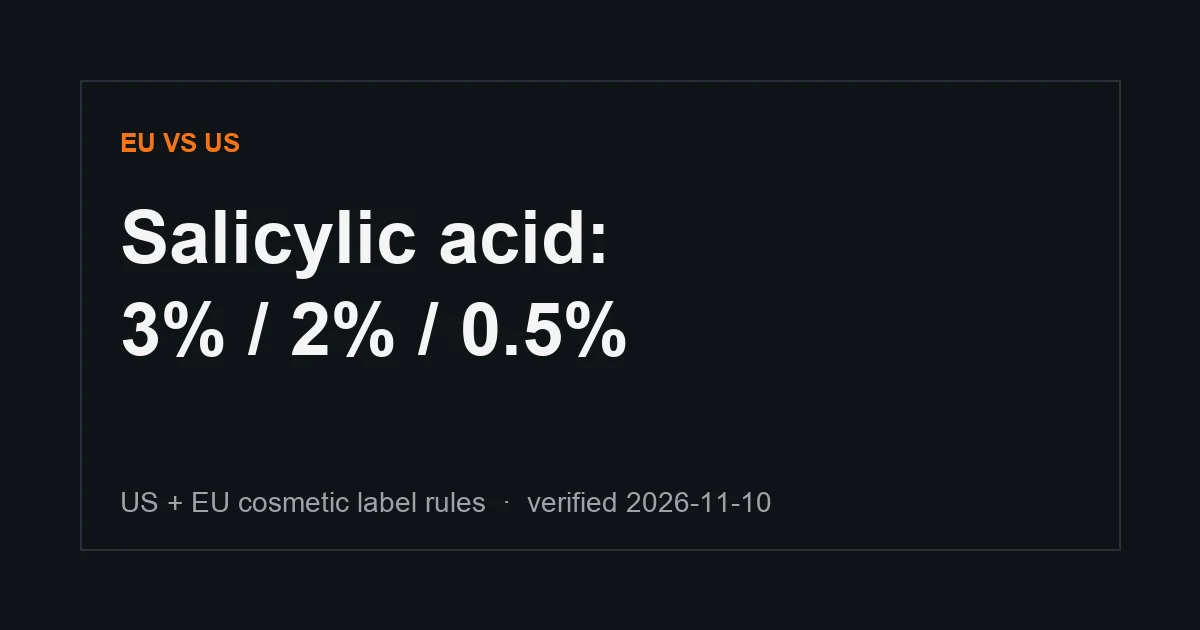
Salicylic acid limits: EU vs US for cosmetics
The EU caps salicylic acid at 3.0%, 2.0% or 0.5% depending on product type (Annex III No 98). The US sets no cosmetic limit but treats acne claims as a drug at 0.5–2%. Side-by-side table and label rules.
EU rules2026/11/10
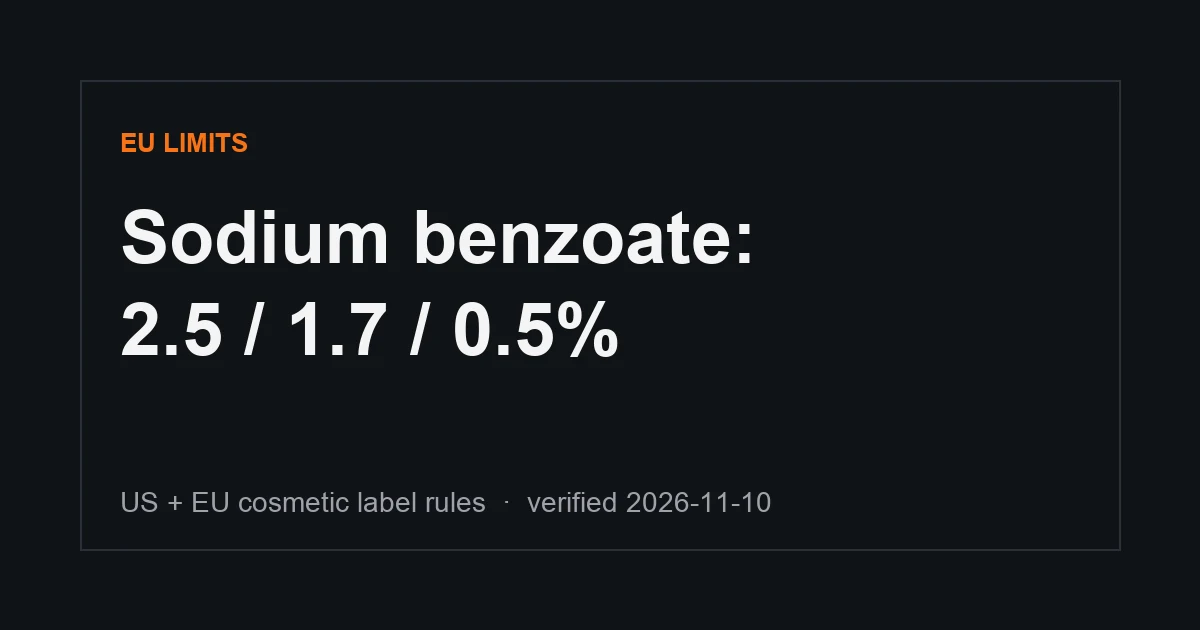
Sodium benzoate in cosmetics: the 2.5%, 1.7% and 0.5% EU limits
In the EU, benzoic acid and sodium benzoate are capped — as acid — at 2.5% in rinse-off, 1.7% in oral products and 0.5% in leave-on cosmetics (Annex V No 1). The US has no federal limit.
EU rules2026/11/10
Triclosan in the EU: which products may use it, at what limit
The EU allows triclosan only in six product types, at up to 0.3%, with a toothpaste ban for children under three and an obligatory warning (Annex V No 25). The US sets no federal cosmetic limit, and triclosan is no longer allowed in OTC antibacterial washes.
EU rules2026/11/10
UV filters in the EU vs the US: what each market allows
The EU allows modern organic filters such as Bemotrizinol (Bis-Ethylhexyloxyphenol Methoxyphenyl Triazine) at 10% (Annex VI No 25) — filters the FDA has not approved for the US. US sunscreens must use FDA-approved active ingredients and are drugs; EU sunscreens are cosmetics.